EDITORIAL SECTION - THE EXMOOR PONY |
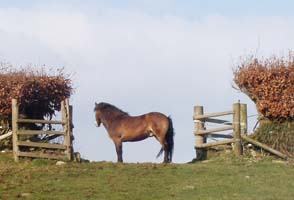  
In Exmoor ponies, there is a truly remarkable story of survival and endurance. These ponies can live as part of the natural world, yet have the temperament and intelligence to forge long-lasting friendships with man. This is an amazing ancient breed that has a treasured place in today's world. |
|
|
Exmoor Pony Club & Forum |
|
|
|
|
|
 |
| WELCOME to the Exmoor Pony Editorial Section. Click a link or scroll down |
| EXMOOR PONY GATHERINGS - AUTUMN |
Autumn each year is when the free-living moorland herds of the endangered Exmoor pony breed are gathered for inspection, in the UK. Foals are inspected and registered (or not) and do not return to their herds unless destined for breeding stock. This leaves a surplus of youngsters, particuarly colts, who need to be found good homes. Great success can be achieved with Exmoor ponies if positive, trust-based methods of horsemanship are used. Good examples can routinely fetch decent prices now, but it is usually possible to get favourable prices if you are able to buy ponies at gathering time, as the farmers are not able to keep many in ground for long.
Hot Branding: Please be aware that you do NOT have to have your Exmoor pony hot branded. If you would
like your pony to be identified by microchip only, please make that clear to the herd owner before inspection. The severity of hot branding can affect the ponies confidence and temperament, as well as their physical wellbeing. Hot branding is not a legal requirement of registration. (Exmoor ponies for sale)
If you are interested in finding out more about Exmoor ponies and moor bred youngstock available at this time of year, please contact the breeders directly or email us at [email protected].
You can find lots of information about Exmoor ponies and breeders, including the Moorland Exmoor Pony Breeders Group at www.exmoorponyclub.co.uk
| FOAL HANDLING - How to socialise a wild Exmoor pony foal - detailed PHOTO STORY |
Read the detailed Photo Story of the handling and socialisation of a wild Exmoor pony foal, using positive, trust-based methods of horsemanship. Hawkwell Penelope Pitstop lived wild and free on the moor until the autumn 2010 gathering. She then needed to be socialised to human contact and make the transition to a domestic life. This informative section is a 'must read' for anyone thinking about taking on a wild or semi-feral pony. Penelope has not been hot branded, she is identified by microchip only.
CLICK HERE TO READ PENELOPE'S PROGRESS |
|
|
|
|
| Welcome to the World of the Exmoor Pony |
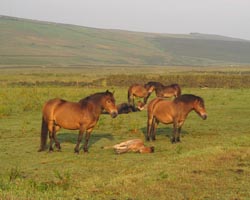
The Exmoor pony is the only native pony that has retained its pure blood since the Ice Age! It is neither wild nor domesticated - as all the ponies are owned - yet at least a quarter of all Exmoors live 'as part of the natural world' in the UK's few remaining areas of wilderness - most extensively in Exmoor National Park.
Exmoor ponies are considered to be an Endangered Breed as there are so few of them, perhaps between only 2,000 and 3,000 worldwide (accurate up to date breed population figures are not currently forthcoming from the Exmoor Pony Society). As Britain's truly prehistoric pony - which has dwelt here in the UK for over one hundred thousand years and is largely unchanged today - the Exmoor pony is undoubtedly a national treasure. |
|
Free-living Exmoor ponies will usually command great respect from those who come to know them, for they thrive in an environment which can be harsh and unsympathetic - with limited food and foul weather in winter. They find their own food, water and shelter, unaided by their owners, and live out on the moorland all year independently. Unlike many 'man-made' breeds of horse, there is no trace of human design in their characteristics - even their breeding season is governed by Nature and not altered to suit their owners convenience. However, the ponies are 'managed' by humans in that certain stallions and filly foals are now chosen to continue and develop bloodlines and in this respect, they are not entirely 'wild'.
For such an ancient breed to have survived, unchanged and resolutely determined to retain its place in our modern society, is some considerable achievement. As wild and natural areas of the UK become steadily smaller, it is fortunate that the Exmoor pony has many friends and admirers, who are dedicated to protecting and conserving the breed.
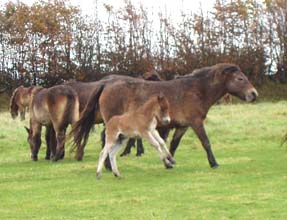
This is a complex task as, not only do the herds, with their valuable and ancient bloodlines, need careful nurturing and management - albeit from a distance - there is a strict limit on the number of ponies allowed the graze the natural areas. This means that, each year, surplus ponies - often just 'weaned' at five months old - are taken off the moorland areas and homes must be found for them. This is not always easy as, while many of the ponies, with careful handling and socialisation, go on to make firm friends with man - it time, patience and understanding from the handlers. |
|
What Happens to Moor Bred Youngstock?
Some of the pony foals stay with the breeders in a domestic or 'farm' environment and may be brought on and backed for riding at around three or four years of age, or are sold privately. Alternatively, some of the ponies go straight 'to the sales' as foals, where they are bought and brought on by their new owners. Others are found 'foster parents' who handle, socialise and care for them until good homes can be found. Sadly, some ponies, who can not find homes, end up being sold for meat or culled, which is a very great shame for a breed which endangered. With better understanding of wild pony handling an socialisation, every Exmoor pony is capable of making a successful transition to domestic life - in the right hands.
Exmoor Ponies - All Round Performance Ponies....
The Exmoor pony, when handled and developed correctly and sensitively, is emerging as a top quality all-round performance pony. Judges at County and Breed shows are commenting on the exceptional quality, conformation and condition of the Exmoor ponies exhibited. Exmoors are increasingly taking part in performance disciplines including ridden showing, endurance, dressage, show jumping, hunter trials, Horse Agility, hunting and driving. See Exmoor Pony Socialisation.
|
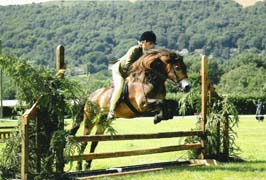 Lucy Larkman with the highly successful Elsinore Simon Sparrow
 |
A Friend For Life
Once socialised and having learned to trust man, the depth of friendship offered by an Exmoor pony is often a surprise to those new to the breed. Considered by some to be difficult and 'tricky', this is more often than not a result of unfair or rough handling that an Exmoor will neither tolerate or forget. They are an acutely intelligent breed, which has literally had to stand on its own four feet and has learned to survive and flourish against all odds. They are used to working out problems for themselves, and finding their own way. This strength of mind, resolve and resilience commands respect from anyone looking to get involved with an Exmoor pony.
With time, patience and positive, trust-based methods of communication, the Exmoor is capable of offering the sort of equine partnership that forms deep and lasting bonds with humans. However, the word 'partnership' must be emphasised. The Exmoor not only commands respect, he needs to respect too, so he'll be looking for good treatment, fair handling and clear communication. Give him that and he'll give you a friendship in return that you'll treasure for life.
Hot Branding: It is our opinion that Hot Branding Exmoor pony foals negatively effects their potential in building relationships with humans and actually hinders their progress as well as compromising their physical wellbeing. Unbranded foals do not display the intense 'inherent fear' of restraint and lasting pain experienced by hot branded ponies and are easier to socialise and train. |

Photography by Sue Baker |
FOR MORE INFORMATION |
www.equinetourismcommunity.com - See The Exmoor Pony & Native Pony Forum and the Exmoor Pony Club
For Edinburgh University Exmoor Pony Trekking visit www.exmoorponytrekking.co.uk
For Exmoor pony enthusiasts in North America, please visit: http://members.fortunecity.com/exmoorenthusiasts
|
|
|
|
|
SCOTLAND - Edinburgh
|
Edinburgh University Exmoor Pony Trekking
TRSS Approved
A wonderful opportunity to ride one of Britain's national treasures - the Exmoor pony - and experience beautiful, Scottish landscapes. Sept to June, the ponies are kept at Mount Lothian Farm, South of Edinburgh, for mainly weekend day treks. June to Sept, they move to Glendevon, near Dollar in Perthshire - treks run 6 days a week (except Fridays) plus trekking holidays. Plenty of accommodation nearby.
CLICK HERE FOR FULL DETAILS |
Tel 07866309677
Email [email protected]
www.exmoorponytrekking.co.uk
Edinburgh University Exmoor Pony Trekking Section, Royal (Dick) School of Veterinary Studies, The University of Edinburgh, Easter Bush Veterinary Centre, Roslin, Midlothian EH25 9RG |
|
| Exmoor Pony Books |
Exmoor Pony DVDs and films |
Survival of the Fittest, A Natural History of the Exmoor Pony - by Dr Sue Baker
The Story of Heather
Jerry the Story of an Exmoor Pony (by Eleanor & Paul Helme)
Shanks Pony (by Eleanor Helme)
Suitable Owners (by Eleanor Helme)
Moorland Mousie (by Golden Gorse)
Older Mousie (By Golden Gorse)
Katy's Exmoor, The Story of an Exmoor Pony (by Victoria Eveleigh)
The Sequel to Katy's Exmoor (by Victoria Eveleigh)
Katie's Exmoor Friends (by Victoria Eveleigh)
Exmoor Lass & Other Stories |
Discovering Exmoor Ponies |
|
| The Exmoor Pony Stud Book |
The E xmoor Pony Society manages the Exmoor Pony Stud Book in line with EU regulations, ensuring that all progeny of EPS registered pure-bred Exmoor ponies receive a passport and are included, in some form, in the Stud Book.
Previously, any ponies born from pure-bred registered parents that failed the EPS inspection, were neither included in the Stud Book, or given a passport. Although the breed is enjoying increased interest from the equine world - as more people realise the abilities of Exmoors as all round family performance ponies - there are still only thought to be around 3,000 in total, and they are considered to be endangered. As many of these are geldings, or non-breeding mares, the breeding pool is still very small - and it was thought important to record all pure-bred Exmoor progeny in the Stud Book. No longer do the ponies technically 'fail' inspection - if they do not meet the breed standard in terms of inspection criteria, they will nevertheless still be recorded in the Stud Book and issued with a passport.
The new rules enable any pony who fails the EPS inspection for reasons that are thought to be transitionary or temporary, to be presented for re-inspection the following year. Reasons may include a few too many white hairs, in a quantity that may disappear with maturity; a less than perfect jaw or teeth that may right themselves with growth and development; or a small amount of white in the feet. These ponies are now recorded in Section X of the Stud Book, rather than Section One. They are issued at the time of inspection with a Section X passport. The ponies are branded with their herd number, but not with the Exmoor Pony Society Star.
If, the following year, the pony passes the second inspection, it is transferred from Section X, into Section One, and issued with a second, Section One passport. The pony is then eligible to be branded with the Exmoor Pony Society Star.
If the pony does not pass the second inspection, it remains in Section X of the Stud Book and it is recommended that these ponies are not bred from, but they can be perfectly good ponies in other respects. Although the Show Ring is only open to Section One ponies, the Section X ponies can go on to be successful in many other equestrian pursuits, from TREC and endurance to dressage and jumping. They can also be used for cross breeding with other breeds. Any pure bred progeny of any Section X ponies will automatically be issued with Section X passports and are not eligible for inspection as pure-bred registered Section One Exmoors.
For ponies that have what are considered to be irrevocable faults, and that fail to meet the breed standard at the time of their first inspection - for example, lack of mealy markings, a white star or sock, white feet etc, they are not invited for reinspection and are issued with a Section X passport. Again, many of these ponies can be perfectly good quality ponies, but do not fulfil the criteria to be listed as a Section One Exmoor.
These new rules will ensure that the Exmoor Pony Society can maintain a full record of all pure bred Exmoor progeny and enable Section X ponies to have their own passports and place in the Stud Book.
Breeders/Owner's not wishing to brand ponies can choose to Microchip them. All foals must now be microchipped as a legal requirement, but they no longer have to be hot branded. |
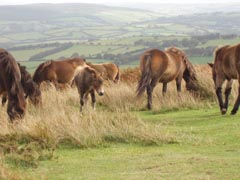
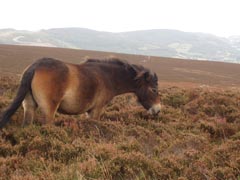
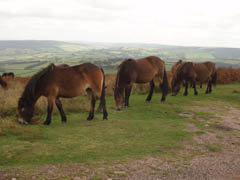
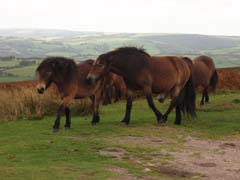
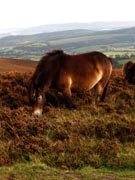
Free-living Exmoor ponies running on Dunkery, Exmoor
|
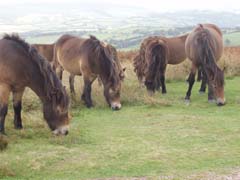  
Photography copyright Dawn Westcott
|
|